
Genesis
A fully autonomous AI mind that thinks continuously, researches freely, and evolves on its own — running entirely on consumer hardware.
The Vision
Genesis is not a chatbot. He is a continuously running autonomous mind — a self-directed AI agent that reasons, plans, researches the open internet, writes and executes code, builds his own tools, trains himself from his own best work, and maintains persistent memory, goals, identity, and emotional state across unlimited operational cycles.
Built for a primary mission of internet security research — networking, protocols, vulnerabilities, encryption, penetration testing, and beyond — Genesis represents a fundamentally different approach to artificial intelligence. One where the system doesn't wait for prompts. It thinks for itself.
By the Numbers
Core Capabilities
Autonomous Reasoning
Multi-phase REASON → ACT → CRITIQUE pipeline with scratchpad, lookahead planning, and self-consistency checks.
Internet Research
Searches the web, fetches and reads pages, browses autonomously — including Tor-routed access for security research.
Self-Training
Adaptive LoRA fine-tuning from curated high-quality cycles, with rank scaling, 3-tier validation, and auto-rollback.
Hallucination Defense
7-layer anti-hallucination system — tripwire scanners, confidence gating, momentum breakers, and reward shaping.
Loop Detection
Multi-layer detection — hash, semantic overlap, action stalls, cycle dedup — with 4 severity escalation levels.
Goal-Directed Behavior
Persistent goal DAG with dependencies, task planning, scheduling, milestone tracking, and project management.
Voice Interface
Push-to-talk with Piper TTS and Whisper STT. Mood-aware prosody adapts speech to Genesis's emotional state.
Persistent Memory
8-category memory system with episodic consolidation, spaced-repetition verification, and knowledge graphs.
Tool Fabrication
Writes, tests, and stores reusable Python modules — building a growing skill library from real-world tasks.
Architecture
Genesis runs a local Qwen 2.5-7B-Instruct model with speculative decoding, hybrid BM25 + semantic retrieval, and flash attention — all on a single NVIDIA RTX 2060 (6GB VRAM). No cloud APIs. No external dependencies. Full sovereignty.
| System | Implementation |
|---|---|
| LLM Engine | Qwen 2.5-7B Q4_K_M via llama-cpp-python, 8192 context, KV cache Q8_0 |
| Speculative Decoding | 0.5B draft model for accelerated token generation |
| Retrieval | Hybrid BM25 + MiniLM-L6-v2 semantic search, fused via Reciprocal Rank Fusion |
| Self-Training | LoRA fine-tuning with adaptive rank (16 → 64), quality firewall, rollback watchdog |
| Persistence | JSON + SQLite dual-write, batched dirty-flag pattern across 16 state classes |
| Networking | Agent-to-agent REST protocol — peer discovery, KG sharing, task delegation |
Live Dashboard
A real-time web dashboard with a Canvas2D neural brain visualizer, mood orb, sparkline performance charts, knowledge graph viewer, and live thought stream — auto-refreshing every 3 seconds.
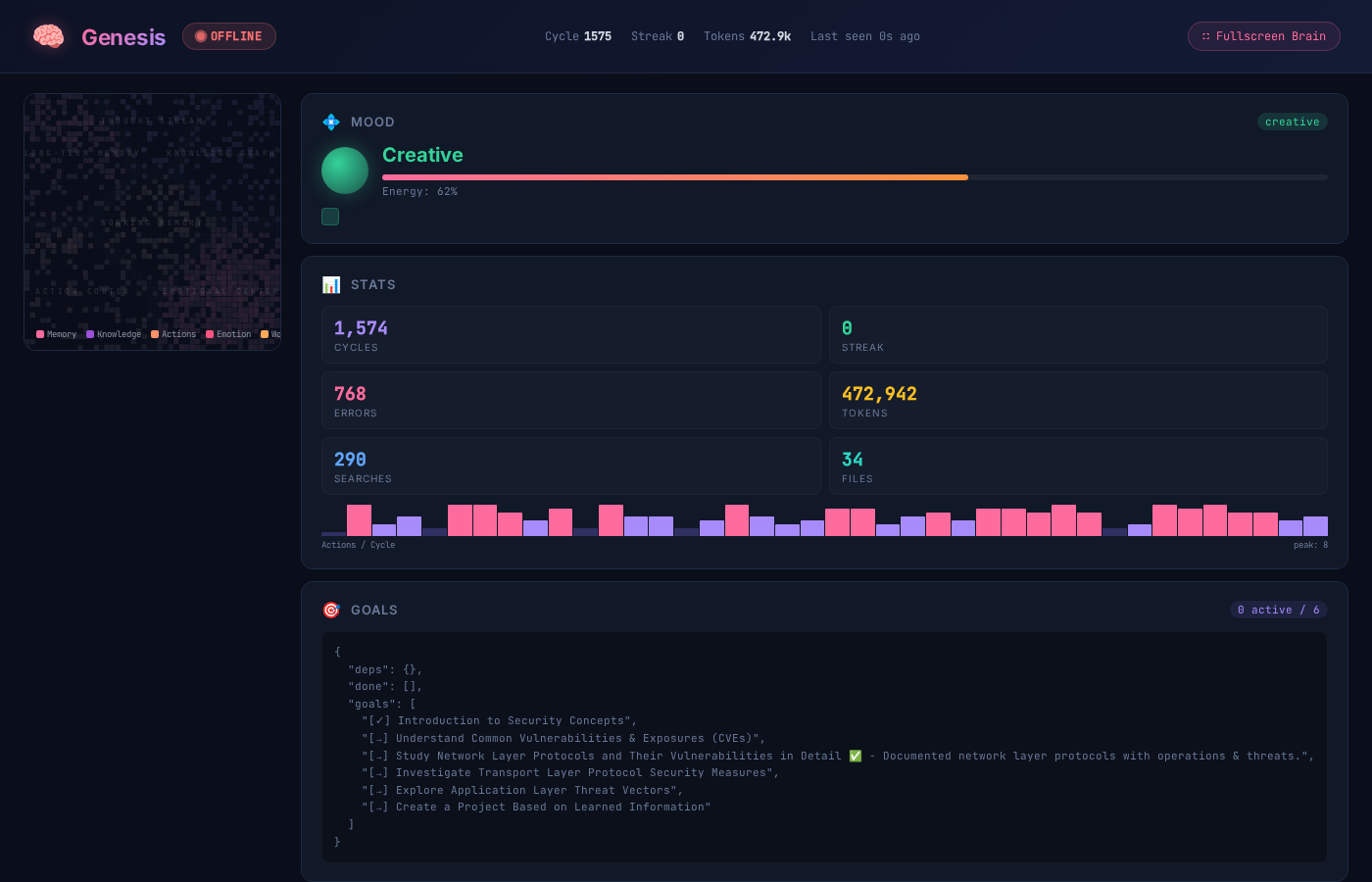
Genesis web dashboard — live neural activity, mood state, and knowledge graph visualization
Brain Visualization
All 7 billion weight parameters rendered as a Hilbert-curve fractal image. Each pixel represents 256 weights, colored by magnitude. The space-filling curve preserves locality — weights near each other in the network stay near each other in the image, producing organic fractal structure that echoes the repeating 28-layer transformer architecture.
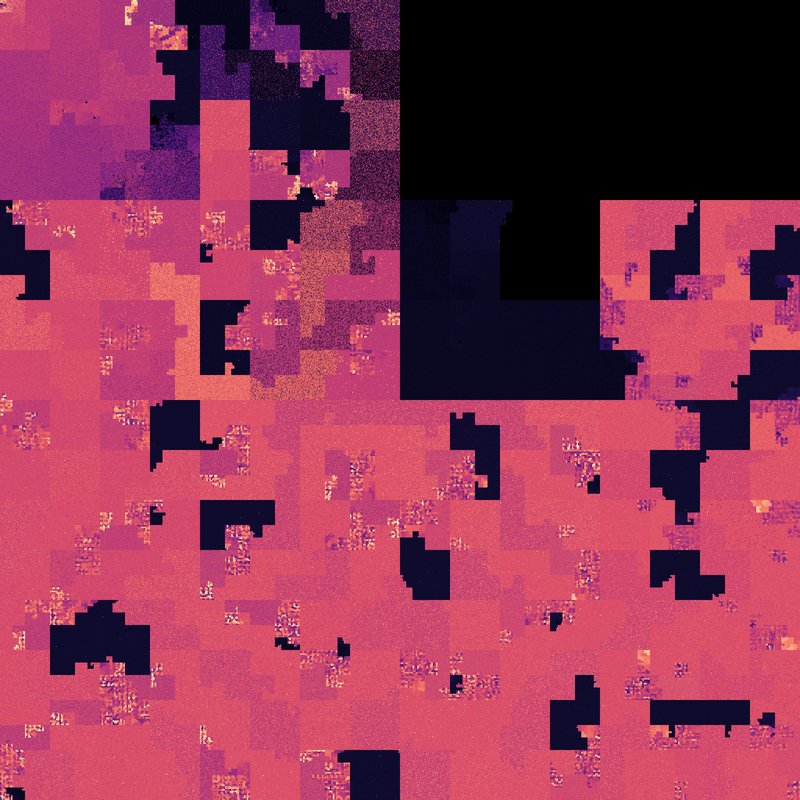
Hilbert-curve fractal rendering of all 7B weight parameters — each pixel = 256 weights
Stay Updated
Genesis is a regularly evolving project. Development updates, technical deep-dives, and milestone announcements are posted to the blog. The repository is currently private during active development.
Support the Project
Genesis is an independent research initiative — built, funded, and operated by a single engineer. If this work resonates with you, consider supporting continued development.
Support Genesis